August 8th, 2005 §

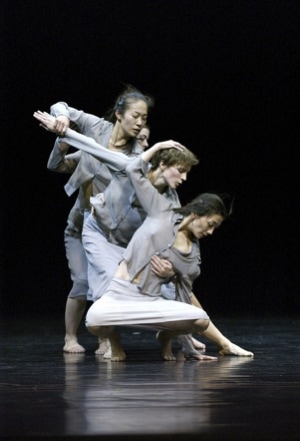
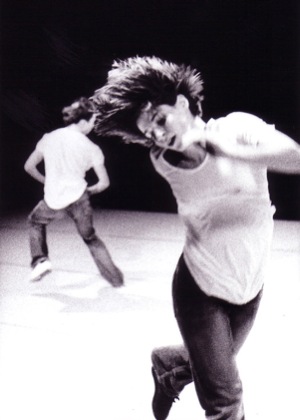
Fuga-Ce original cast at Volksopera:
from front Tomoko Nishino, Leonie Wahl,
Tae Hee Kim, Esther Koller
I first saw Fuga-Ce or at least the core of it two years ago in the Vienna Volksopera. It was an impressive piece of dance. There were works by four of the best of independent dance in Vienna that night (Tanztheater Homunculus, Tanz Hotel and x.IDA were the others). To my mind the Tanz Company Gervasi piece was the stand out.
His dancers were so fast and musical. The interweaving dance that Elio Gervasi had wrought for them left not a moment of idleness to the mind. It was like watching shooting stars. If one were to blink one would miss so much.
What is at Impulstanz this year is a revision of Fuga-ce with the collaboration of Catherine Guerin, a choreographer well-known in Austria for her collaboration with the Graz Opera and Tanz, Graz ballet director Darrel Toulon.
Fuga-Ce is the second Guerin-Gervasi collaboration. Earlier this year, Darrel Toulon brought them together in Graz to create Metamorphosen in Graz. In Graz, there were three choreographers to work on Metamorphosen (Iva Rohlik was the third). Unlike shared choreographic programs, Metamorphosen was not divided into distinct sections for each choreographer but was a single show. All choreographers had full input at all times in the creation of the final composition.
I had the privilege of seeing that experiment in group authorship earlier this spring and could see some of Elio Gervasi's phrasing in the composition but do not know the work of Catherine Guerin or Iva Rohlik well enough to distinguish their contributions. While there were some fine moments in Metamorphosen, as a whole I found it not entirely coherent choreographically, made up of mismatched fragments. I laud Darrel Toulon's audacity to always find a new way to approach the choreographic art, whether by retreating cinematic stories in dance, turning the grand classics on their head with his small company or in this case attempting multiple authorship. As with many grand experiments, success is not always assured but there is something to learn from the process.
That is to say, it is extremely interesting that Elio Gervasi and Catherine Guerin have chosen to continue the experiment of creation by multiple choreographic hands of their own free will. No longer is it the idea of the artistic director hiring them.
The version of Fuga-Ce at Impulstanz is much longer as it is now a full evening piece as opposed to one of four small pieces. The aesthetic is much looser. There is a comparatively elaborate set with three metal panels at the back of the stage and dozens of wooden blocks with metal rods sticking out of them. The costumes are no longer monochromatic grey but a variety of sombre browns and reds and blues.

Fuga-Ce original costumes: Tae Hee Kim
There are six dancers instead of four. When there were four they were almost all close to the same height and proportions. Most disconcerting about the additional dancers is that one is much taller than the others and one is much smaller. The symmetry of the earlier production of Fuga-Ce is gone.
What was improved this year was the addition of live music to the performance with the Keller Quartet at the Akademietheater performance. Sadly in the showing at Arsenal there was no live music.
The lighting from Markus Schwarz was excellent. Studio One at Arsenal is the same empty space in which Philipp Gehmacher's incubator took place with all the atmosphere of an empty aircraft hangar. For Fugua-Ce, Schwarz had managed to put in a full lighting rig.
When we entered the hall it was almost dark and we had to find our places carefully. He finally brought the house lights down and then brought small pools of light up all over the stage, nine in all revealing the strange forest of metal sticks in wooden blocks.
The dancers moved to one pool to another. Sometimes dancing whirling solos, sometimes dancing fantastic and energetic duets. With the size differential some of the dancers seemed to take on a male role and a female role this year.
All the dancers, as is wont with the Tanz Gervasi Company, were very good. Elio Gervasi's choreography is very quick and demanding of the dancers. Leonie Wahl showed extreme speed and vigour and perhaps more precision than at the Volksopera. Tae Hee Kim was exceptionally smooth and strong throughout the piece. Esther Kollers danced with characteristic grace and lightness of touch.
Of the new dancers, the tall one seemed somewhat out of place. While very athletic, she lacked the precision and softness characteristic of Gervasi dancers. The new blonde dancer seemed a little bit cold and to think her way too hard through the piece. The final new dancer - while too short for the company - revealed herself to be fluid and passionate in her movements. The fire in her movement was a welcome addition to the rather cerebral emotions of Fuga-Ce.
In the tendency of almost all of the productions at Impulstanz this year, the revised Fuga-Ce could not pass up noises from the dancer. At the end of the extended choreographic meditation on Bach, Leonie Wahl stands on her head. After a moment on her head, as the other dancers slide away into the darkness she begins to occasionally bark. Two minutes later she drops down into a crouch, takes a Russian looking fur hat, pulls it tight on her head and scrabbles away into the dark, some sort of peculiar gollem creature or perhaps a homeless person.
All of these additions of dancers and metal forests and different colours in the costume and barking on one's head did nothing to add to the piece for me. But nor did they deprive a very strong work of its core - smooth and dramatic dancing from a musical and fluent troupe.
A refreshing change from the comedic sketches and experimental theatre under the dance banner this past week.
August 6th, 2005 §

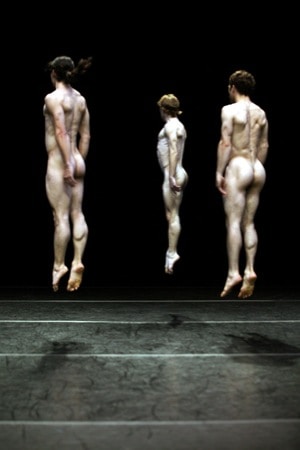
The Modesty of Icebergs - Photo J. Grenier
Another one of the poster productions of this year's Impulstanz, Daniel Leveillé's new work is graced not only by the strong image of three naked men flying but also by a chillingly poetic title The Modesty of Icebergs (La pudeur des icebergs). I expected the most.
In the splendidly intimate Akademietheater, The Modesty of Icebergs was very slow to start. The dancers did not come into the half-darkened hall until quarter after nine.
Three men strode out from the back right corner (Mathieu Campeau, Stéphane Gladyszewski, Emmanuel Proulx). Totally naked as the poster promised. They promptly set themselves out in a staggered row of three and began to pose. It was like some sort of strange body building contest where they pliéd and puffed-out their chests in strange half squatting positions.
The piece is difficult to describe as there was no particular narrative but rather a cyclical repetition of the same movements with an ensemble comprised mainly of three men but augmented at times to as many as five men and one woman (Ivana Milicevic).
A highlight of the dance for me were the series of leaps the dancers made onto one another's hands. Sometimes the other dancer would push the leaper backwards across the stage in the air, as if he were flying. Other times, the dancer would leap up on top of the walking dancer suspended by their own hands on shoulders and the hands of their carrier directly vertical at the midriff. The dancer would be carried clear across the stage in this dramatic pose. If you've ever seen someone portage a canoe, you will have some idea of the geometry involved.
Others were very moved by a piling on of bodies in which they found some emotional succour in the rather cold show.
One becomes accustomed to the full male frontal nudity in a positive way. All the dancers are fairly ordinary looking men (mid-way through the piece a curly haired man with huge limpid eyes and a lush mouth appears like an overgrown cupid, as the exception to prove the rule). Some with rounder butt cheeks and more robust chests, others with more slender grace, but authentic looking men. The investigation of male form is intrinsically fascinating, as it is so rarely done. In most professional sports like hockey or even baseball, the participants are so attired as to reveal little. This is one of the great attractions of basketball as a very popular spectator sports for women. But event there the motion is repetitive quick and not especially revealing.
Yet a consistent low point in the choreography for me was an insistence on the male sphincter by Daniel Leveillé. There were three poses in which we were obliged to confont our dancers' crack in the most intimate way possible. One in which the dancer turns his back to us, bends his knees halfway and then bends over towards the floor. This was perhaps the most off-putting. Another was when the dancers lowered themselves to the floor in splits and then rolled over on to their backs and finally used their hands to spread their butts. The third was to place the dancers again back to us, but kneeling on the floor, butt directly towards us.
Frankly, I found this emphasis on the anus distracting and worse the revealing poses highly contrived. Unpleasant artifice in off-topic sensationalism. A half-hearted descent into male pornography with no link to the rest of the piece. Apparently these are poses which baboons will make in pre-combat situations. Perhaps Leveillé was trying to recall our primate origins.
The music was repetitive - exclusively fragments of Fédéric Chopin's Préludes op. 28. There were long passages of silence. The silence allowed us to hear the dancers movements on the stage very distinctly which offered another rhythm to the ear.
I found the alternation between silence music very stimulating. On the other hand, Chopin and silence can be a powerful somnificant.

Daniel Léveillé - Photo R. Laporte
Towards the end of the piece the eye contact between dancers becomes ferociously intense, as if they were consumed by hatred or envy of one another. I did not quite understand their sudden emotional intensity.
As an étude on the male body, as an exploration of certain types of movement, Daniel Leveillé's The Modesty of Icebergs does not dissapoint. But somehow the whole is less than the sum of its parts.
An often-heard complaint was one of length. But at one hour and fifteen minutes The Modesty of Icebergs is not particularly long. Simply there was perhaps neither enough choreographic nor emotional content to play for more than forty minutes. The Modesty of Icebergs was slow-moving. But so are icebergs.
A well-written and enthusiastic Montréal review Naked Angels.
A concise quality video extract from The Modesty of Icebergs.
August 5th, 2005 §
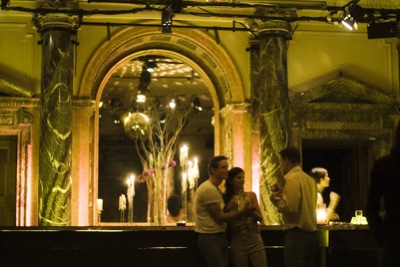
The main late night haunt of the Impulstanz Festival is the Bürgtheater Vestibule, one of the more charming and elegant bars in Vienna, located within the Bürgtheater just to the left of the main entrance.
(More pictures of the splendid Bürgtheater interiors, see previous post.)

The main bar. Waitress passing in background

Waitress dancing by herself:
a bad plan in motion
Normally there are too many people in the bar to take a decent picture, but on this Monday night after one a.m. there was the requisite calm. An excellent trancy music set from the DJ passing through on his way to Zürich.
Good conversation with Leonie Wahl and Markus Schwarz, dancer and light designer from the Elio Gervasi's Tanz Company. We were joined by Ricardo Cosendey, who creates the sets for most of the Gervasi productions. Politics and dance. General consensus, but for another longer article, that there is far too much unpleasant experimental theatre masquerading as dance. Not that any of us have anything against experimental theatre, but it has its own public and by driving dance audiences away from the art, we are all at risk.
Topic inspired by an extremely drab evening of performances at Schauspielhaus, Etienne Guillote's
Skéné and Ingrid Reisetbauer's
Drängen.
Bonus portrait of Leonie Wahl. Elio Gervasi's Company is blessed with some of Vienna's most lovely and precise dancers.
August 2nd, 2005 §
Woman collapses on stage.
A bleached out video shows on a large plasma screen on the left hand wall of the theatre. It is a high-angle overhead view of somewhere in downtown Vienna in near-winter. People wander by four Mozart concert ticket sellers in capes. The ticket sellers talk mainly to one another as there are few of their habitual prey (foreign tourists) wandering by on the busy morning. A woman passes with her dog every five minutes, reminding us that it is a loop.
The video is important as it sets an urban environment, a bleached-out emotional landscape and a Viennese context.
At some point our collapsed dancer (Ingrid Reisetbauer, the choreographer) starts to emit guttural shouts.
Mainly a lot of sitting on the stage with a bored look on her face and staring at the audience with disinterested disgust. Reisetbauer's character is attired in an ugly green top and ill-fitting trousers. Her hair-do is particularly pernicious, managing to be both up and mussy at the same time.
A lot of painful looking floorwork.
Later while Reisetbauer lies face down on the stage, she begins to pump her hips up and down hard on the floor. As if she were humping a lover. On her face the disgusted and bored look remains. In her emotional voyage, I think we are to understand that this is her sex life. Perfunctory and empty. Her lovers bring no more emotional content into her life than the floor.
In general we are facing an absolute discomfort with body and space.
Fist it should be said that in the tasks Ingrid Reisetbauer sets herself - generating discomfort, disgust, ennui - her success is outstanding.
I disagree with her ends in principle. To my mind, dance is supposed to bring one closer to one's body, not drive one further away from it.
Towards the end of Drängen, Reisetbauer leaps off the stage and lingers a moment in front of the audience as if searching for a victim upon which to hurl herself. Given the extremity of her performance the audience is genuinely discomfited to find her persona among us.
Happily enough she trots up to the back of the auditorium and disappears. An empty stage. Silence. Reisetbauer reappears to sing out loud and discordantly and repeatedly hum.
And thank heavens it is finally over. Twenty-five of the longest minutes of my life.
Another Vienna piece, like the one from Philipp Gehmacher, about boredom and disgust with urban life.
Here we are facing an ugly if clear performance by an artist who makes herself as insupportable as possible. In difference to Gehmacher's incubator, at least Ingrid Reisetbauer moves around - Drängen is legitimately a dance piece. Again, unlike Gehmacher, Reisetbauer is succinct in delivering her dour life statement.
But neither incubator nor Drängen have anything to do with life in Vienna, whether mine or those whom I know. Vienna is a beautiful and lively city, filled with all kinds of delighful and gorgeous people.
Some part of the modern dance crowd seem to have mutually poisoned one another to all light and beauty. I wish they would find themselves a support group instead of inflicting their angst on the public.
The stürm und drang of early French existentialists but without the languid expressiveness of Camus' or Sartre's texts.
Decades of work from Tanztheater Homunculus, Tanz Company Gervasi and Impulstanz itself have gone into building up a modern dance public. My concern is that these tanzextentialists will drive all audiences from dance theatres in this city. And then life will really be bleak. In a worst case scenario, we are facing a self-fulfilling prophecy.
For masochists only.
August 2nd, 2005 §
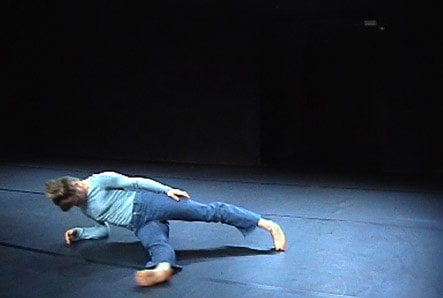
Bare black stage. A girl stands. A fallen chair. The girl rolls on to her back.
A single overhead light allumes. Girl rises. Dressed in in plain white t-shirt and very blue jeans.
Silence.
She turns on the chair. A vicious attention. Kicks the chair melodically across the stage.
Intimacy and hatred in an inanimate object.
Strong projection of personality. Not a typical dancer's body, but beautiful, flexible and powerful. Somehow very true.

Claire Croizé in Skéné
Unfortunately these first five minutes were the high point of the show.
The rest of the mercifully short piece (less than one hour) involved a lot of arm twisting to very loud Mozart.
Only the charisma and physical presence of Clara Croizé kept the audience in the theatre. At some point Etienne Guilloteau wandered out himself. He was wearing the same white t-shirt and plain blue jeans as Croizé. He gave himself mainly the same movements as Croizé to execute. This only highlighted the obvious - that he is not nearly the dancer she is.
Guilloteau's pointy little beard and sloppy pony tail only added a focal point to our discontent. His head did not seem to be fully in his performance, at least beside the almost otherworldly concentration of Croizé.
Never did we get as lively an interaction between the human pair, as we saw between Croizé and the chair.
Croizé does get one more peculiar and transfixing solo. She wanders the stage in a circle throwing her arms forward violently and repeatedly to the chords of Symphony No. 25 in G-Minor . Eventually Guilloteau joins her, spoiling a promising moment.
Guilloteau's choreography is simply not at the hauteur of his musical ambitions (Mozart chefs-d'oeuvres).
Nice dancer. Lousy show.
Clare Croizé and Etienne Guilloteau
BIOGRAPHICAL NOTES
Twenty-five year old Croizé is a French born, Belgian-trained (P.A.R.T.S.) dancer who is a choreographer in her own right (Give me something that doesn't die). She has performed for Carlotta Sagna (Public Relation) among others.
Four years Croizé's senior, Guilloteau is also French and a P.A.R.T.S. alumnus who has performed for for Anna Teresa De Keersmaeker (Kassandra), Charlotte Vanden Eynde (Beginning Endings) and Mar Vanrunxt (Deutsche Angst). Skéné appears to be his first professional work as a choreographer. Let's hope for the best.
Photos © Raymond Mallentjer
August 1st, 2005 §
After the Marie Chouinard show in the Bürgtheater, there was a lovely premiere party. At the party, the music was also Bach. At the end of the party Simon Rowe (Serge-Aimé Coulibaly's choreographic assistant and a dancer in Et Demain) and Ellah Nagli (danceWEB Europe 2005) did a wonderful improvisation.
Click on any of the images to see a larger version.