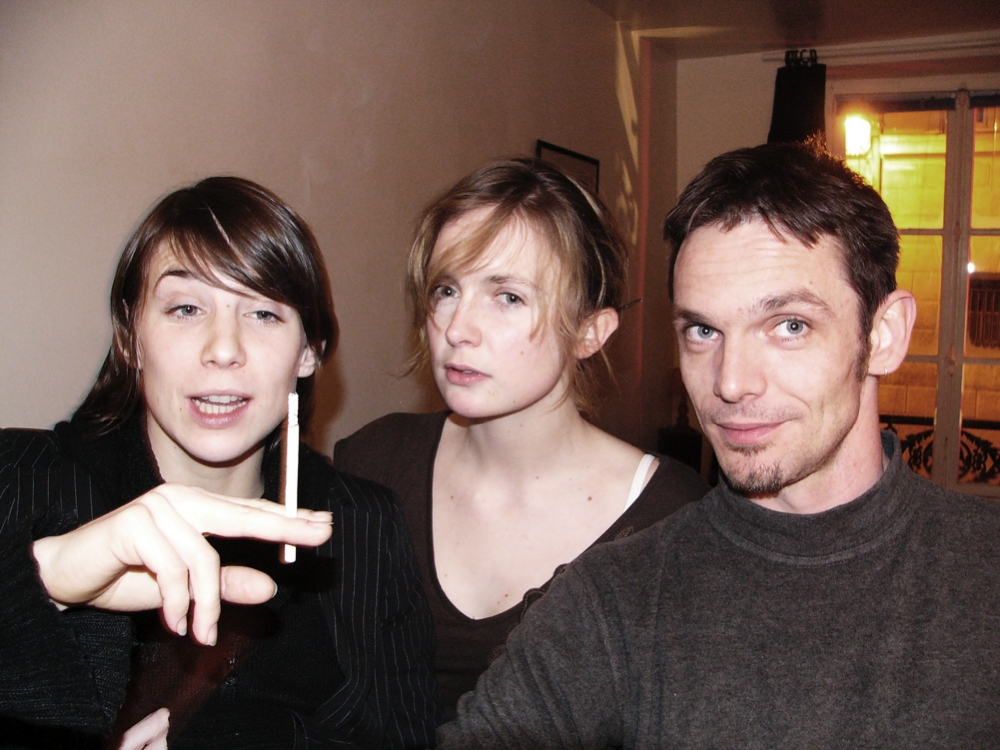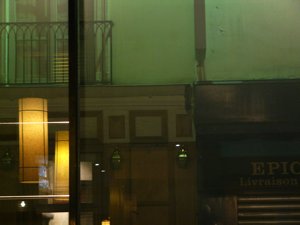
Anna Hein, Valèrie Simphal, Xavier Perrez - rue Mouffetard.
Paris La Nuit - Hein, Simphal, Perrez Continues »
March 7th, 2005 § 0
Anna Hein, Valèrie Simphal, Xavier Perrez - rue Mouffetard.
Paris La Nuit - Hein, Simphal, Perrez Continues »
March 7th, 2005 § 1
Deux photos de Valèrie Simphal, 5 mars 2005.
Prêter son appareil est bien.
January 27th, 2005 § 0
France is not doing very well these days.
Prices have rocketed sky-high despite wages staying more or less in the same place.
One of the problems is the 35 hour work week. On my trip to Basque country I rode the train with a woman who works in a large Belgian bank as upper middle management. She can't get her whole staff together for a meeting anymore as there is always someone who is not at work. The 35 hours week legislation even allows workers to set their own hours! Frankly, thirty-five hours is not enough time to do a full-time job, especially on the clock. Between arriving and leaving and lunching and coffee, there isn't much time left to work.
Moreover, companies are paying a full wage for these part-time workers so no wonder prices have to rise.
Indicative of how things work in Paris these days is the following anecdote.
For a tiny Sony VAIO PCG-161L that I bought from my cousin, I need a power adapter. Graham lost the original power adapter at the bottom of the Arctic Ocean on one of his Arctic diving expeditions.
So I call up Sony France for the part as no one else seems to have it. Proprietary power connector. Finally get the right number and the right person on the telephone. To call one of these French 0800 numbers you have to pay between 15 and 35 euro cents/minute usually. The money extorted is divided between France Telecom and the company to whom the number belongs. So I'm paying a stiff tarif to talk to them already.
The gentleman on the other end after introducing himself as Monsieur Simon asks me for the model number. I give tell him.
"That will be 20€ please. Would you like to pay on your credit card?" "For what?" The power adapter couldn't be that cheap. "To open a dossier."
I asked him if he had this straight. I was going to call him to buy an after market part for this little box - a part that was certain to cost ten times its production cost to purchase (power adapter) and he intended to charge me 20€ to tell me if he had the part in stock or not?
Yes, he was serious. The computer was not sold originally in France and in such cases a dossier charge of 20€ is obligatory. No wonder there is so much negative press about after sales service on Sony VAIO. Finally a gentleman by the name of Monsieur Coulet, three or four rungs higher in the ladder had the good grace to tell me free of charge that they don't have the part anyway.
This is just a single anecdote.
Another example. The internet providers also give you a toll line for tech support. They keep you on hold for at least ten minutes and then tell you that nobody is available. Repeatedly. They could tell you within 30 seconds but then they wouldn't get to put 2€ in their pocket for every call.
We are a long way from the 1-800 number here.
Basically the deal in France now is that as soon as you do or try anything you get whacked financially three or four times. Once for the telephone fee tarif, another time for some kind of administrative charge and a third time with an absurdly high price.
So what do the beleagured French people do? They try to stay home and buy as little as possible, despite an enormous amount of advertising everywhere.
They don't understand why foreigners are all trying to run around and do everything, as if they are unaware of the consequences of wanting too much in this world.
As well as the salarial woes consequent from the 35 hours, the changeover from the franc to the euro gave the perfect cover for a furious inflation which I gauge at about 25 to 40 per cent depending on the category. With the currency transition it is difficult for even the government to keep track of where exactly inflation is. Retailers have told me that sales are way down. Logical. When people take increases in basic cost of living, without a correspondent wage increase, their disposable income crashes. And they do less.
Lots less. So the retailers, restauranteurs and bar owners seem to have hiked the prices to maintain their revenues. Which again reduces the public. And that is the current situation in Paris. Many places are working almost exclusively for a turnover tourist/visitor population at exploitation prices.
Paris being Paris (one of the centres of world tourism), gouging works after a fashion. But no wonder the resident Parisians are running to work and home again with an ever more anguished expression.
January 26th, 2005 § 0
Every day here in Paris, I miss my Wienerwald (Vienna woods). The Wienerwald are just 20 minutes away from the very centre of Vienna by bike and cover steep hills (not quite mountains).
In Paris there is absolutely no place to hide away from the traffic and the crowds. Almost every day I have been going out for a walk in the Jardin du Luxembourg which is a fabulously beautiful site but is both too structured and too busy to provide any real repose. It is a wonderful place to gather the day's sunshine as if there is any sun, the sunlight gets to the ground at all times of the day somewhere in the Jardin.
The far less well-known Jardin des Plantes is much less visited as it has no tennis or children's playground and is not on the same kind of major transportation axis as Boulevard St Michel and the RER.
On the other hand there are whole sections of the garden which are preserved in a natural state. Indeed about ten years ago they started to fence off the woods so that the natural vegetation would stand a chance of returning to the soil (under the amount of traffic that even the Jardin des Plantes gets in the summer, apparently nothing was growing on the ground and the trees were ailing). In the north-east corner of the Jardin, there is a delightful labyrinth which is in fact a winding circular upward path ending in a gazebo. From the gazebo one can see much of the surrounding Paris and sit and enjoy a winter chat.
There is some delightful solitude and tranquility there now, but that probably passes quickly in spring and is absent summer. Perhaps even more wonderful is at the bottom of the labyrinth, there is a real copse of woods. Enough so that one can see almost only trees on all sides. One can even hear the sound of the wind through the trees. For a moment Paris becomes alive.
A lot easier than a trip to Fontainbleu or Chantilly which are both an hour away from the centre of Paris.
-----------
Not to be missed while in the Jardin des Plantes is the Grande Galerie de L'Évolution au Muséum National d'Histoire Naturelle. The Grand Gallery of Evolution is part of a 19th century zoological exhibit hall with a glass ceiling, very similar architecturally to the Gare d'Orsay now the renown and magnificent Musée d'Orsay.
Inside, instead of finding expressionist paintings and sculpture, one finds five floors of beautifully created diaoramas and life-size preserved animals. All kinds of taxonomy and evolution and habitats and diverse natural trivia come to life in each of these exquisite displays. Most of the text is in French so sadly much of the information will be lost to the non-French speaker.
But for those who can read French, it is like a natural history textbook come to life in three dimensions. Larger than life. Stand next to the rhinocerous of Louis XIV. Walk beside a narwhal. See Polar Bears close up. Go back 500 centuries and 6 centuries in the life of Paris and see the natural environment of the time.
A living expression of why the internet can and should not be the end all of human knowledge. It would take weeks to gather and experience the knowledge concentrated in a few hours visit to this remarkable museum. The Grande Galerie de L'Évolution au Muséum National d'Histoire Naturelle is the perfect expression of the French genius for explication and presentation.
January 5th, 2005 § 2
New Year's eve at Palais Garnier is a marvelous event. One comes in black tie and enjoys complimentary champagne and hors d'oeuvres with the ballet.
The dance on the programme was the baroque event of the Opèra de Paris season.
The evening began rather slowly with Bach-Suite 2, a creation of Francine Lancelot and Kader Belarbi on J.S. Bach's Suite No. 3 for cello in G major, based on Rudolf Noureev's Bach-Suite (1984).
Belarbi's structured dance to Bach's baroque score is correct, historic and vaguely charming. Belarbi was attired in a shiny purple frock coat in the baroque style and he skipped and jumped and leaped. However a man prancing alone in most cases remains a man alone on stage. And in tonight's performance that's exactly what happened.
The highlight was the cello solo performed admirably by Raphaël Pidoux who joined us on the left hand of the stage.
After the first entre-acte we returned to a bare stage with only a background of three white panels. On each of the panels a photograph was projected as a dancer slipped in and out from each side of the stage.
Glacial Decoy is performed in total silence so all we heard was the sound of the projectors changing the photographs and the sound of the dancers feet. The photographs were rather dreary black and white pictures of a rust zone in the United States. As a multimedia piece, Trisha Brown's Glacial Decoy (1979) is quite old so the use of photography and dance together was probably fresher at the epoch.

The performance was smooth and certain. Almost effortless for the five Paris Opera danseuses, Géraldine Wiart, Muriel Zusperreguy, Béatrice Martel, Aurélia Bellet and Alice Renavand. One might say that their performance is missing a certain recklessness or carelessness that one can imagine in the original American dancers.
But the dancers were stunning in the translucent long white gowns as they came and went as ghosts.

A pity that the projectors were so noisy as the mechanical sound of the pictures changing rather distracted from the ethereal atmosphere of the gowns and the choreography.
When the lights came up for O zlozony / O composite, we faced a starry sky projected on a 10 metre high backdrop. Three white clad figures moved about the stage to a woman's whisper in an obscure and delicious Slavic tongue. The music was very zen - almost too much so - but lifted from repetitiveness by the gorgeous spoken vocals.
The music belonged Laurie Andersen and the choreography again to Trisha Brown, but this time in a more recent commission in a creation made specifically for the Opèra de Paris in only its eleventh performance.
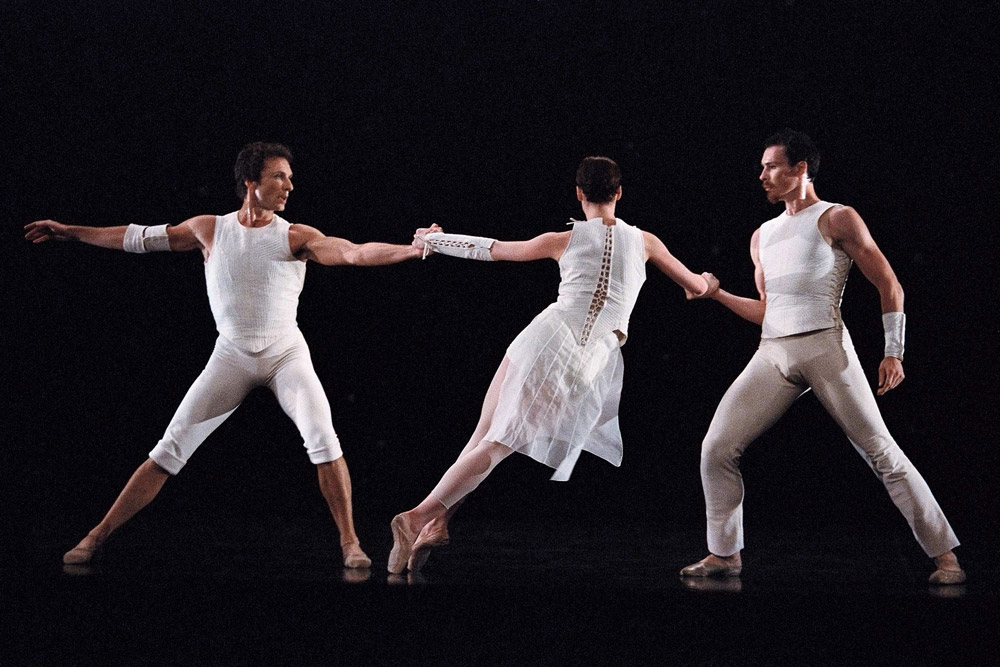
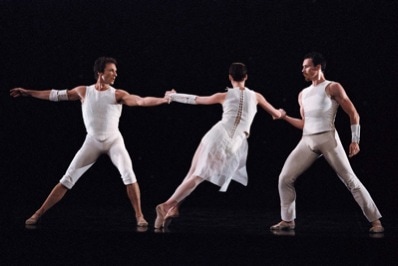
The three performers - Dorothée Gilbert, Nicolas Le Riche and Yann Bridard - were attired in strange curved white costumes, a combination of Barbarella and 2001: A Space Odyssey - modernistic but somehow timeless.
O zlotony / O composite - Legris, Dupont, Le Riche © photo by IcareNicolas Le Riche is a man in his full maturity, with full lines rather than youthful ones that leave a sense of hidden power like a panther. Powerful and flowing arms. Le Riche dominated the other two. Despite the omnipresent female vocals, a strangely bland dance role for the woman. No real dancing, just lifted and twisted and turned.
The kind of piece you'd like to be able to sit down and watch sometimes before bed to put you in a good mood, dreamy and reflective for a blissful night of repose and meditation.
After the second entre acte we returned for what is supposed to be the highlight of the programme, William Forsythe's Pas./Parts created for the Ballet de l'Opèra de Paris in March 1999.
Three enormous white walls. Left, centre, right. The dancers emerge in strong diagonal lines. The men are in colored tops and black bottoms. The women are in black fronted body suits with coloured backs. Yellow, purple, blue.

The strong industrial sounds of Thom Willems score syncopate the dance at first, galvanizing the audience. Sadly after a while they become tired. Perhaps too much post modern clanging on stages around the world. Clanging does not make much of a thirty five minute score.
Here there are up to twenty dancers on the stage at any one time. Again the range and breadth of Opèra dancers impress. Forsythe's choreography for the men and women is very similar but for some reason looked much better on the women. Too stiff on the men.
Sabrina Mallem was particularly impressive with arms that seemed longer than even her legs, both supple and powerful. Totally expressive from head to toe to fingertip, she filled the entire stage with resolute and poetic extensions. The strength of her body expressed itself in the beautiful and rounded curves of her shoulders and hips.
On the other hand, the other lead, Mélanie Hurel, while she danced well, looked so thin that she might be staggering out of prisoner-of-war camp, gaunt and miserable. This is the downside of the Opèra de Paris is that many of the danseuses are so thin as to look outright ill.
While some may find this aesthetically inspiring, I find it depressing to see people who frankly look only ill peforming on stage.
Pas./Parts while it had its moments, dragged at times and sank under the repetitive and unpleasant score. What was said musically and choreographically could have been condensed into fifteen or twenty minutes rather than thirty-five.
Overall, though, a wonderful and varied program, with a single unique and original piece in Trisha Brown's O zlozony / O composite.
No regrets, recommended.
December 7th, 2004 § 0
for the longest time, i would have nothing to do with german speaking women even conceptually. my single experience in this domain was the daughter of a consul who lived with my first girlfriend and shared the bed with us when i stayed over with the two of them.
brigitta corresponded to the clichéd foreign portrait of a german woman. she was exceptionally pneumatic with an enormous heaving bosom and massive rubenesque thighs. in this surfeit of flesh, she managed to have quite a small waist. she had curly blonde hair and prodigious appetites and a very sharp german accent employed vigorously to express her demanding personality.
considering that this teutonic maiden was probably the final hatchet into that first relationship, i forswore her kind for what i thought was a lifetime.
large pneumatic blondes and harsh accents have never been at all to my taste. a reason to avoid california and australia for that matter. soft speech, rounded consonants, long vowels, dark hair and light eyes are my synonyms for bliss.
and so a lifetime of mainly russia and france and wondering occasionally what it was i was missing in italy or spain. never a thought for german-speaking lands except how to exclude them from my travel plans.
well the image above - nothing could be further from the truth. particularly in austria. the austrian accent in english is completely different from the german one. it is soft and sultry. much clearer than the french accent in english and i would argue far more sexy. of course, nothing is more beautiful to the ear than a well spoken french woman speaking her native tongue but in english, nothing exceeds the grace of an austrian mädchen. almost all of them have it. particularly outstanding is a carinthian speaking english but at this point we are splitting hairs. the austrian accent is great. if you want to check up on it, just call austrian airlines from anywhere in the world.
but not all is well. particularly in germany there are a large number of excessively large girls and women. like canada, germany is a beer-drinking country. and as a group german girls drink beer, like the men. nothing spoils a woman's figure like beer (or a man's for that matter but men are not on the agenda today).
austria happily enough is more of a wine-drinking country. while the men do drink beer, the austrians are very keen on all kinds of things mixed with soda and lemonade (beer and lemonade is a radler), white wine and soda is a weissspritzer and red wine and mineral water is a rotspritzer and apple juice and soda is obspritzer. also popular is the italian prosecco (a sort of semi-sweet champagne), as well as white wines of all kinds. many women drink exclusively these beverages and consequently have very good figures and often retain fine boned grace into their thirties and beyond.
the women from german speaking lands are very different from their french counterparts. they are far less likely to talk an excessive amount of superficial nonsense. they would like to speak about what it is of interest to them. and to the point. they tend not to flirt very much aimlessly. you can trust that if a woman is paying attention to you for the moment at least she is interested in what you are saying. this may or may not be a good thing - some in france argue that the flirt is the lifeblood of gracious society. others consider it naught but a nuisance.
often the women retain good figures as a fair amount of outdoor activity is considered part of a good upbringing. any well brought-up austrian lass should be able to do a good few hours on steep hiking trails without trouble or complaint. the more adept among them even contrive to do hard-core climbing with the men. cycling and swimming are practiced through old age. not to participate in sports and outdoor activity almost marks a girl as lower caste or unwell in austrian society.
on the other hand, the women as a group do not try to rival the men. so in a group of mountain bikers one cannot expect the women to match the men for either strength or endurance. the physical condition of the women has polite limits, often made tighter but the unfortunate and widespread practice of smoking. but as a group they are stronger and more svelte and fitter than canadian, french or russians.
apart from their lovely accents (in the case of the austrians) and their good figures, the appeal of women from the german speaking lands is this: they are hard-working, clean and sober as a group.
the general level of habitation is so high - square corners, clean floors, sparkling bathrooms - that it is a national norm. women are highly social creatures, very sensitive to societal standards. when everybody's house is clean and immaculate, the pressure to meet the general standard is very high.
moreover, cleaning and maintaining a house properly is a kind of craft, a sort of guildmanship, which is passed from generation to generation. women born and raised in these lands - depending on the household, of course - have that savoir-faire. just as in french households, women have the savoir-faire of making extremely good dinners and running a soirée end to end.
this is not to say that in france the women keep dirty households or that austrian women, for example, can't cook. but as a rule one would find houses in german speaking lands significantly cleaner with better bathrooms, while one would find the general level of culinary expertise significantly higher in france.
in exchange for their ability to keep a household in fine order, women from the german speaking lands do expect the man to participate in the general cleaning, even if the woman is ultimately responsible for the overall standard. they also expect a man to be compliant (not necessarily obedient. his own belonging must also be kept in good order.
moreover, they cannot abide dirtiness in a man's person. french women and russian women are far more tolerant of the body in a natural state. canadian women are don't like dirt either but they are uptight about everything, including men's bodies as well as their own. no doubt someone will mention that there is promiscuity in canada as well. yes, but it is a brutal promiscuity - a promiscuity which leaves the woman's partner in debauch with more of a sensation of sleeping with a brazen prostitute than an act of tender intimacy (the women of quebec are a happy exception in all of this english speaking canadian ascetism.)
particularly unpleasant to many german speaking women is the act of fellatio. it is amazingly unpopular here. women from german-speaking lands would far rather have straight sex than oral sex.
in america, apparently it is the inverse. the young women - from presidential interns to walmart clerks - think nothing of a quick BJ. it a conceptual differnce. bill clinton maintained that he "didn't have sex" even after the stains were found.
in seeking an explanation for this, the best i could come up with is that in austria the men's loins often smell and are unclean. at least that is what my informal sampling revealed as the greatest complaint about fellatio among austrian women. at the root of austrian men's hygiene problem is their generally uncircumcised state. austrian women are very negative about oral sex, at least the performing of it, as past experience has taught them to expect a very unpleasant experience in taste and odour; once convinced of the cleanliness of the man their enthusiasm climbs substantially, and many even acquire a taste for fellatio.
CONCLUSION
from my original position of staying as far away from the women of german-speaking lands as possible, at this point i have to recommend them very highly with only a single caveat. for all the delight and good in them, their native tongue remains german.
which is neither graceful or lovely. in my experience one is ill-advised to sustain a long-term relationship with a woman whose native language you do not at least understand, as a woman's character is far more deeply embedded in her natural dialect than the characterless international english she is likely to speak.
to speak to her in english is to drink wine with one's nose plugged. one has only the faintest idea of the nectar that one quaffs.
October 13th, 2004 § 0
Au cœur de la Dordogne anglaise:
Ces résidents britanniques ne viennent pas à Eymet pour être vus sur un marché à la mode, comme ces « célébrités » parisiennes qui prennent leurs quartiers d’été dans le Luberon, mais pour faire des emplettes et aussi pour se retrouver et savourer ensemble un concentré de ce qui les a conduits à s’expatrier : la good life symbolisée par ces fruits et légumes en abondance, ces produits du terroir, ce restaurant qui sert du rosé et du monbazillac bien frais, le temps qui s’écoule lentement, le soleil. Tout cela dans le décor d’une superbe bastide du Moyen Age. Le cliché de la vie au pays des châteaux – au sens propre, tant ils sont nombreux en Périgord – vue des brumes d’Albion, mais un cliché que beaucoup ont converti en réalité au cours de ces dernières décennies.
Beats the fogs of London, let me tell you, winters in Périgord. A good meal can be had in London but expect to travel and expect to pay about £40 per person for what would cost €15 in Périgord.
And even then, you're still not in Périgord.
But one can only hope that this mode anglaise not become too popular. It would be shame to see the South West overrun like Spain with beet red uncouth brutes.
January 5th, 2004 § 0
visited the AGO today for the last day of the degas bronze scuplture exhibition. loathesome work. the degression of scuplture since the greeks is astonishing.
of course, i love rodin's work. the power of his bronzes. the scale of the work. but degas' work in scuplture is largely an afterthought. he only created one bronze for exhibit in his lifetime, la danseuse à quatorze ans.
all the rest are fabrications. another sculptor went in and working on the basis of wax and plasticine models of dancers created by degas for his paintings.
why would degas create these things if not as works of art? ever tried keeping a constant supply of modeling dancers around? not easy. it makes perfect sense to capture their poses in 3D to better transpose them to two dimensions later.
moreover, the one finished work, la danseuse à quatorze was the only one which looked finished. her skin is smooth. the details of her face are precise, the costume is worked out and is even partly in real chiffon.
in contrast, the artist's life bronzed life models are almost all roughly hewn and imprecise. just the notion of motion captured in their limbs. and of course dancers' bodies in motion have a certain magic. but not when their limbs, faces, joints are unfinished blobs of sloppy bronze.
in any case, the gallery was full of the usual fatuous bourgeoisie cooing over what happened to fill the rooms of the second floor of the AGO.
in praise of the exhibit, one of the largest rooms was devoted to sketching from life models. when i was there on a sunday afternoon, the life model was but a jointed wooden skeleton, but all the walls were plastered with visitors stab at degas' style charcoal drawing.
much closer the spirit of his fabulous drawings.
the emperor has no clothes yet again.