
March 13th, 2006 §
The last good goaparty I went to was in February. This last while I've just been deluged with work. I took some pictures but not as many as I usually do. The decoration was fabulous at Fiat Lux! - Es werde Licht. People were wonderschön. Lots of friends and acquaintances.
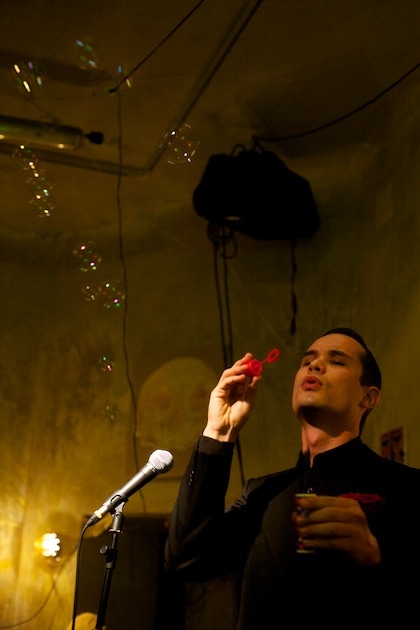
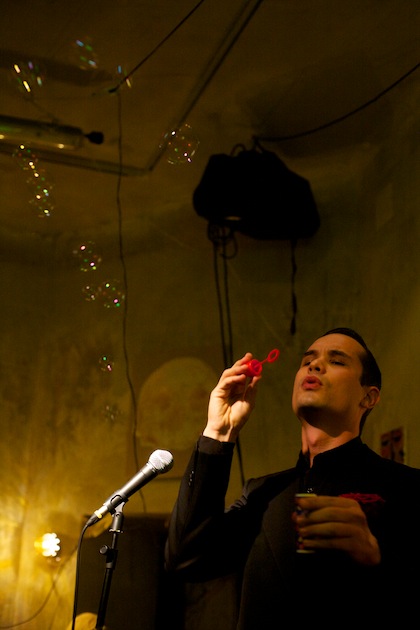
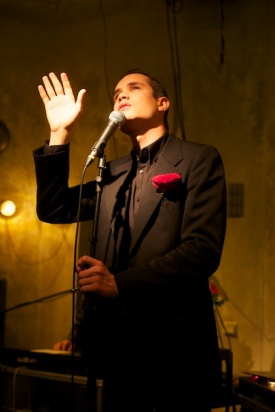
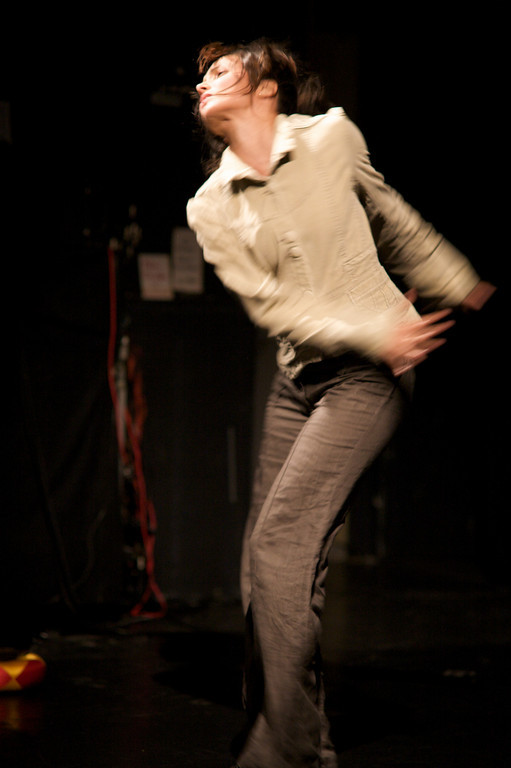
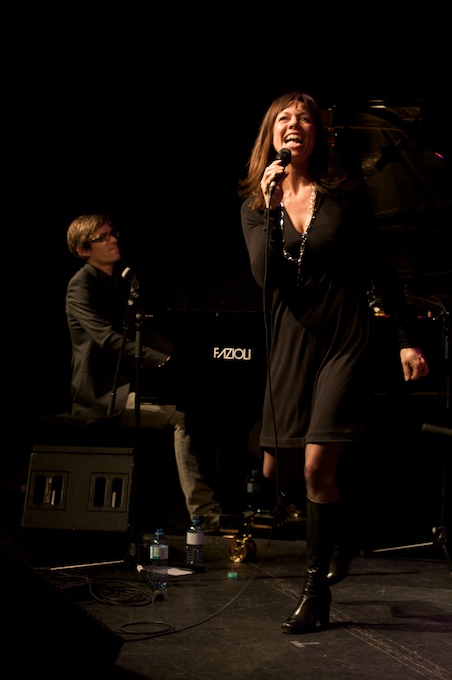
The best set of the night was played by the beautiful and ethereal Gaby. What was amazing was as she played she danced, playing the music for herself and the crowd. It was almost like a live-set, she hit the mood so well.

I thought what a beautiful Austrian girl - no, DJane Gaby is Slovenian. Met another beautiful girl there as well her boyfriend. She turned out to be Ukrainian. Vienna the capital of beautiful women from elsewhere. I know more beautiful Polish, Russian, Georgian, Ukrainian, Czech, Slovakian, Serbian and Slovenian women here than Austrians.
I suppose nothing much has changed from the days of the Austro-Hungarian Empire. The standard of living is higher in Vienna and life is better organised here. So many people from the old Empire still continue to come through Vienna in a traditional pattern. The fall of the Empire is still less than a hundred years ago.
But the evening was not about beauty but music and light. And Gaby's set flowed so high and far that when the curtain came down hard at 6am the publich was not too happy. The DJ's had to hide for almost 15 minutes while the organisers worked on dispersing the crowd.
If you get the chance to attend a party where DJane Gaby is at the tables, it is an event not to be missed.
It was a very good thing that Gaby came on. The main event DJ of the night (might be her boyfriend from what I can tell - if so I hope Gaby gives him lessons on playing to a crowd) was a serious letdown. I'm not sure if it was Indika (Mexico) or Phenix (Austria). The music just drifted, not going up or down. No real goa feeling to float on. Just another techno/trance type evening. Lots of enjoyment to be had in the small room though.
There was an after party but I don't have the force to go somewhere else at seven in the morning. Bed is too sweet. It was a beautiful sunny morning I remember. The day after pictures are actually sunset when I went out for a walk to Heldenplatz and then to Rathaus where I observed the Eistraum. For once, Toronto outdoes Vienna. For the rather cramped skating quarters at Rathaus, one had to pay something like 6 euros to skate. The skating rink at Nathan Philips Square is much bigger and it's free.

Apparently there is fabulous skating on the Donaukanal. I missed it this year (a good icy skating day is a rotten day for cycling - next year I'll just have to take the U-bahn).
I haven't managed to hit the nightlife much for the last few weeks. It's a combination of things. So much work. And also with the camera, it adds yet another task. I am also tired of all the smoke, both from cigarettes and smoke machines. Too many nights.
And instead of goa a whole lot of balls. Pictures to come shortly.
Vienna world capital of the Viennese Ball and of GoaTrance.
January 27th, 2006 §
Of all the arts, dance and poetry are my true passions.
So I've seen a lot of dance in Vienna. Been to the theatre a few times. I have yet to see an opera.
The dance this season has been deeply disappointing since the fabulous Jan Fabre-blessed season at Tanzquartier a couple of years ago. The dance which is being commissioned and presented is conceptual. Abstract.
Hardly dance at all.
So in despair I have turned to music, buying a host of albums which I will review here, going to concerts at Flex, becoming a member at Porgy and Bess.
I've often said dance is the poetry of motion. One could turn the definition on its head and say that poetry is the dance of language.
At the root of both poetry and dance is music.
There are only a few things which Austrians do better than anyone else in the world. One is skiing. The other is music.
The ballet orchestra at Staatsoper is head and shoulders above any other in the world. I recently attended an evening of As You Like It. The choreography is dull, the characterisation trite, but to hear the Staatsoper orchestra play Mozart made for an excellent evening.
I would never have guessed that a people who are so repressed emotionally - living in Vienna is like a timewarp to English Canada 30 years ago where repressed emotions were also the order of the day - could be so expressive emotionally.
All this repression can be agreeable at times - very rarely does one see people shouting at one another in the streets here. Bar fights or harsh words are rare. People are remarkably calm in the course of a day's interaction.
Somehow all this repression must force the emotions out elsewhere.
And it appear the outlet is music.
I am tired of second-rate dance or worse not dance masquerading as dance.
So I will be writing a lot about music this year.
November 20th, 2005 §
I had the chance to hear Electric Indigo live again on Friday night at Flex where she played the Jugend Innovativ party. Her set was long and fabulous. What marks the outstanding DJ from the ordinary, is his or her ability to tap a room's animus and move the people from where they are into the DJ's world. This isn't done with a single song or single riff but with a careful musical progression, even a spiritual center.
Electric Indigo is often called Austria's best woman DJ or the World's best electronic woman DJ. Time to drop the gender epithet. Electric Indigo may be the most consistently brilliant electronic DJ in the world. Full stop. I have heard her spin at least a half dozen times since I came to Vienna two years ago and her set was always outstanding.
She has her own record label (unfortunately the representative MP3 files are not representative of her sets) and maintains an international music resource site called female pressure. Here is an extract from her official bio:
Electric Indigo, DJ and musician, has rocked clubs, raves, and festivals in 34 countries. Her name stands for an intelligent interpretation of the terms "techno" and "party". She started her DJ career in Vienna in 1989 with jazz and funk sets, but soon found her style in the Detroit and Chicago techno sound. In her Berlin years (1993-1996), she was responsible for purchasing and communication for the legendary record dealer Hard Wax. In 1998 she created female:pressure, an international database for female DJs, producers, and visual artists who work in the fields of electronic music. female:pressure is a unique, web-based resource of female talent all around the globe and was built to enhance mutual support and communication as well as the general level of information about female artists.
Catch Electric Indigo next in Vienna at flex on 12 December and at Tanzquartier 22 December. For her worldwide dates online.
August 12th, 2005 §
For the PONI performance, I have some authentic pictures of the event. PONI is a Brussels based international performance band.
We saw PONI the night before as part of the We are all Marlene Dietrich FOR show at Akademietheater. I preferred their performance in the context of the larger show.
Left to their own devices, PONI has no shortage of entertaining tricks. Many different kinds of masks, body painting, bondage with electric cords, hysteria.
As a group they have tremendous energy.
But musically it felt too much like a direct assault on our sensibilities rather than a complex voyage. Their roots are deep in punk. If you are missing punk from the eighties dressed up in a modern sensibility PONI is not to be missed.
Here are the pictures:

Main PONI front man Rodolphe Coster, Belgium

PONI - Erna Ómarsdóttir, Iceland

Julie Andrée T, Montréal
Kate McIntosh, New Zealand

Kate McIntosh in bondage

Applause in Casino am Schwarzenbergplatz
The concert and the closing concert took place in the Casino on Schwarzenbergplatz. Many of the parties have been here and it has been a good location with its baroque elegeance, high ceilings but a certain casual energy. The Casino is also one of the second stages for the Bürgtheater. Every last Friday during the theatre season, the Bürgtheater actors put on a small show on this stage as part of an internal program of artistic development.
The party itself didn't have quite energy of the opening party as at the end of a month of festival and workshops, people are a little bit tired. There are another five days of performances to go and three days of workshop. I was warned at the start of Impulstanz to take it slowly. It was good advice. I will follow it next year.
If you get the chance to come to Vienna and participate in Impulstanz it is not to be missed. It is the best organised and most enjoyable festival in the world with the possible exception of TIFF (Toronto International Film Festival) which is many times the size. Great dance, great parties, great staff, great city.
Photos - Alec Kinnear
April 28th, 2005 §
Anyone who has any doubts about what the major record labels do to artists and why one should support independent artists whenever possible, should have a look at Janis Ian's long piece on music downloads. As a recording artist for the last twenty years, Ms. Ian has seen all the systems come and go. She's had her own grief and pain with them and seen others win and lost more. In short, she has the long perspective on how we got to where we are now.
Among the astonishing revelations is how her label insisted on negotiating a reduced royalty rate with her for CD's as they were a new medium. And subsequently sold the CD's at a price higher than the original vinyl.
Beside brigands like this, filesharers are naught but modern-day Robin Hoods sharing the music widely. As Ms. Ian points out every new listener is a potential concert goer or someone who may purchase her albums as a gift for others. Frankly I also often see people who discover music via downloads (legal or illegal) subsequently go on to purchase the CD's afterwards.
BMG has a strict policy for artists buying their own CDs to sell at concerts - $11 per CD. They know very well that most of us lose money if we have to pay that much; the point is to keep the big record stores happy by ensuring sales go to them. What actually happens is no sales to us or the stores.)
NARAS and RIAA are moaning about the little mom & pop stores being shoved out of business; no one worked harder to shove them out than our own industry, which greeted every new Tower or mega-music store with glee, and offered steep discounts to Target and WalMart et al for stocking CDs. The Internet has zero to do with store closings and lowered sales.
And for those of us with major label contracts who want some of our music available for free downloading... well, the record companies own our masters, our outtakes, even our demos, and they won't allow it. Furthermore, they own our voices for the duration of the contract, so we can't even post a live track for downloading!
If you think about it, the music industry should be rejoicing at this new technological advance! Here's a fool-proof way to deliver music to millions who might otherwise never purchase a CD in a store. The cross-marketing opportunities are unbelievable. It's instantaneous, costs are minimal, shipping non-existant...a staggering vehicle for higher earnings and lower costs. Instead, they're running around like chickens with their heads cut off, bleeding on everyone and making no sense. As an alternative to encrypting everything, and tying up money for years (potentially decades) fighting consumer suits demanding their first amendment rights be protected (which have always gone to the consumer, as witness the availability of blank and unencrypted VHS tapes and casettes), why not take a tip from book publishers and writers?
As Courtney Love suggested in one famous discourse, one would better reward one's favorite artist by downloading their music and sending a cheque for $20 to their own address - than by purchasing it in a store. They would make more money than if you went in to buy five of their albums in a store.
More examples and information on recording royalties here.
February 11th, 2005 §
Finally
someone gets it right with online music. A
curated weekly gallery of high quality songs from both known and unknown artists. The slant seems to be rock/pop in English, but the quality is very high.
What the editor at Fingertips seems to understand better than
Joshua Ellis at Mperia is that
the importance of editorial filtering in promoting independent music. We don't want to have the raw Reuters or AFP newsfeeds in our kitchens spewing out the largely irrelevant (to us) news of the world. We want the sections which we follow and understand edited to a size we can digest. This is what fingertips offers:
just because there is an eye-opening amount of free,
legally available music online these days doesn't mean the good stuff is easy to find.
I believe, in fact, that good music has never been harder to find. It's quite
the conundrum, actually--there is more good music being produced than ever before
in history, and yet it's harder to find than ever.
Free, legal MP3s are particularly hard to find, as they tend to be scattered across hundreds if
not thousands of different web sites around the world.
And it doesn't help that free, legal MP3s of quality are inescapably lost in a
morass of free, legal MP3s of shall we say questionable quality. Because (alas!)
the flip side of there being more good music being produced than ever before is
(you guessed it) there is also more mediocre music (let's not call it
"bad"; people are trying their best, after all!) being produced than
ever before.
While fingertips is brilliant as online concept and music editorial, there is no commercial transaction for the artists. By sharing some quality MP3's, they do attract new fans. Many of whom will pay for CD quality versions after a short period. When you have four of the nine tracks in 128 bit MP3 of one of your new favorite albums, how long will you deprive yourself of the other five, the whole lot in CD quality? Not long is my wager.
So with quality online editorial guiding our selection to quality artists who are new to us (who very well may have had twenty year careers before we find them), all the artists need is a venue from which to offer their music. While each artist can set up his or her own website, there is a lot of redundant work, drudgery and expense in maintaining online commerce.
What independent music artists really need are places where the editorial selection is uniformly high and the prices reasonable in order to flourish and overwhelm the majors. We could call them mini-labels.
While working on the
sound track album and press package for Lapinthrope, I think I may have found such a place. In France of all places. It is called Ocean Music. There are
just seven signed artists, of which I am familiar with the music of three. They are all wonderful. Their music shares enough traits - sophisticated lyrics and wonderful voices - to interest one another's fans.
Lapinthrope composer Rachel Smith has just signed with them to create a new album with Clearing producer Karl Mohr.
The only catch is that while one can order the music online, one has to wait for regular CD delivery. All the music should be available for online download at reduced prices (no physical product). As I've suggested in the past, music lovers have a set monthly budget which is likely only to increase if prices go down. If the expense and trouble of trying new music is reduced, we will do more of it. And once I've bought one album from an artist in electronic format, if I like it I am likely to buy most of the rest in CD format. If I never buy the first album - time, trouble, expense - I'm not likely to buy any of the others.
Hopefully the independent music vendors and artists will click on that concept one of these years soon.
Highly recommended.
December 6th, 2004 §
There is a house in Vienna, they call Soulsugar.
Every Sunday night in Vienna for the last couple of years, a time machine operates from about nine o'clock at night. Some space in the city (presently the Moulin Rouge) becomes part of the 1960's and 1970's. In these rooms, the music is James Brown and the soul pop of the epoch. No fear of ever hearing Michael Jackson or Tina Turner's Private Dancer or any of the other dross of the eighties. Strictly prohibited, a rigorous selection that never breaks the spell. But very soul-oriented. You would be unlikely to hear The Byrds or Donovan here either.
In fact, a huge part of the music could be part of the French Nouvelle Vague cinema. On the walls, they show old super 8 movies of the epoch in endless loops. They used to loops from softcore of the period but lately they have been home movies.
In a crowd which is mainly from twenty to twenty-eight years old, most people come dressed as though they too were living in the Woodstock era, but without the same excess. One cannot grow an afro overnight and the afro is not a natural hairstyle to most Austrians. The other option for dress is a sort of natty French nouvelle vague look.
The Moulin Rouge is a particularly appropriate setting for Soulsugar with its red velvet and enormous old cocktail bar. It has balconies everywhere and deepset booths and heavy iron work as if from la Belle Epoque. Timeless enough and old enough to transport us far from the present.
The crowd at Soulsugar comes to dance. Which is good, as there are many places in Vienna where the people are there more to pose than anything else. Many of them actually know how to. There is an enthusiastic and giddy atmosphere. For better or worse, the people are without pretension.
Strange that these people seek every week to step back into the world their parents would have inhabited. An idealised version of that world of course without Viet Nam, drug overdoses or the Cold War. But a happy illusion, that one is happy to wrap oneself in for a few hours. Good music, friendly people, easy times.
The creators of Soulsugar add some lovely extras. The costumed girl selling candy, free massage, two-for-one cocktails before 11.
In a sense, the escapism of Soulsugar is a microcosm of the zeitgeist in Austria. Austrians would prefer to just not think about world problems just now. Their country is enough to them. They feel secure within their borders (what borders I would ask, considering their presence within the old EU and right at the edge of the expanded one). Austria is rich, secure and free. Long may it remain so.
An Austrian once compared his compatriots to Hobbits and Austria to the Shire. He was not far off, except that Austrians are somewhat taller and the women are very enticing.
MOULIN ROUGE - 1010 Vienna Walfischgasse 11. Admission is on a sliding scale depending on when you arrive. €3 before nine. Double or more afterwards. There is a five euro entrance list you can sign up for in advance to be able to go at the time of your choice.
November 8th, 2004 §
Chicago Tribune | The selling of dance:
Who attends dance performances?
The Chicago Community Trust, with help from Prince Charitable Trusts, funded research that focused on the local dance audience. The profiling data, gleaned from the phone surveys and focus groups with arts patrons, are to be used to help dance companies gain broader recognition and boost ticket sales. A look inside the demographics of "dance attenders," or those who have attend-ed one or more professional dance performances in the last year.
71% are female (29 percent male).
56 years old, on average.
77% are white (12 percent Latino, 7 percent Black).
63% are urban dwellers (37 percent live in suburbs).
59% took dance classes growing up.
60% do artistic or creative activities themselves.
The number in there which really surprised me is that sixty per cent of those who attend dance, practiced at one point or another. It's true that there are always a significant proportion of current professional dancers, dance teacher, ex-prima ballerinas as well as a legion of young people presently studying dance in most given audiences.
Many times I have taken culturally aware people (who go to at least one of museums, theatre or art cinema regularly) to dance performances. Usually mixed results. They are not often sold on making it a regular part of their lives. They think of it more as a curiosity than anything else.
Oftentimes, either the music is alienating. Most of the classical ballet canon, apart from Diaghilev's Ballets Russes pieces scored by Stravinsky or taken from Rimsky-Korsakov symphonies, are set to wretchedly banal scores, Swan Lake the notable exception. Even Giselle is maudlin. Or the modern stuff is just cacophonous. Or to sparse to be enjoyed (a single high hat being tinkled twice on the minute).
In modern dance in North America (and to a lesser extent in Europe) one suffers from the "anyone can be a dancer" train of thought, which considers that not personal beauty, stage charisma or dance talent should play a deciding factor in one's ability to express oneself via movement in front of others. In classical dance in North America, audiences all suffer from the Auschwitz factor. The gentlemen who rule the roost have no great taste for the female figure. And so the female dancers are all young Adonis without rounded shoulder or bottoms or breast. Not a curve in sight.
These twig figures are hardly muses or and in many cases are barely recognisable as humans, let alone adult human females. Fortunately in Europe, the female dancers, depending on the company, are far more authentically proportioned. And thus more pleasing to the untrained eye. Perhaps it should not be a surprise that ballet enjoys wider favour among audiences in European cities.
So just how does one expand dance audiences? The eternal question.
In my particular case, take beautiful pictures of dance and publicise dance as widely as possible. Personal experience has shown this not to be enough.
More pleasing performers and consistently higher calibre music would help enormously. In any case, that strategy worked for Diaghilev.
But in general it would seem that answer would be to expand dance schools and train as many people as possible in Terpsichore's art.
As a remedy for the general gracelessness of the world and problems of form, this would probably offer considerable both health and aesthetic benefits. Perhaps the Health Ministries should get involved.
A supple body and awareness of the body contribute mightily to a good intimate life. Perhaps the tabloids and the women's magazines could join the effort.
October 13th, 2004 §
Apparently all is not well in the world of Blue Note fans. The worst thing to happen to them were the Grammies that Norah Jones won. The triumph of Capitalism with a capital C. Her success caused controversy on the company forums. The forums were taken down, scattering and angering the fan base which had kept the company running for twenty years.
MediaPost Advertising & Media Directory:
[Blue Note] seemed oblivious to the uproar they had caused their fan base, because quite honestly, these weren't their fan base anymore. Their fan base were the people buying Norah Jones records. These other people were part of some other time and place. They were good for a couple of thousand in sales, but in their entire history didn't buy as many albums as Norah Jones sold in a few short weeks.
And the passion, loyalty, and emotional investment these folks had made in this brand over their entire lives - it was expendable, inconsequential, and misplaced brand equity. Welcome to Norah Jonestown.
The whole article is worth a read for anyone interested in jazz or the business of music. Or even scalable web solutions.
July 3rd, 2004 §
Macbidouille, a superb French language Apple information site, has published the following letter from a record producer in France - after confirming the facts.
Apparently download royalties are for them and not for others.
I am the co-director of 5 titles on the next album of [a French artist] that is to be released in october. The artistic director has a contract with the le producer (the major) for arranging, orchestrating, and artistically direct and supervise an artist's recordings for a determined amount of titles, as seen in the contract. According to the contrat, the client (the major) gives money to the producers as a fee on every CD sold. About that project, as paying online music dowload sites such as the iTMS had appeared, I dared asking [the major] how much I'd get for those titles from this album sold on such a site.
The enclosed mail answered quite frankly : NO FEE for me on donwloads. Which simply means [the major] will perceive the rights paid by Apple yet refuses to give any part of those to the artists, directors and other rights owners.Which is perfectly illegal. [Major] states that the contracts between us talk of a "support" such as a CD, cassette, vinyl etc., yet for downloads, there is no support, so no reason we are given anything.
Yet, [the major] is negociating with Apple about how much fee they'll perceive on any download made of the works we've created for them. My opinion is, and many artists and directors agree, this is a widescale and more insidious piracy than any other.
I've been doing that job for over 40 years and as a mixer or a director I took part in over 40,000,000 sold disks, yet I do not even own my flat.)
Personally, I buy many records from independent artists these days but will do my best to avoid giving my money to major record labels as so little of the money goes to the artist.
Who's the real pirate here - the major record labels.